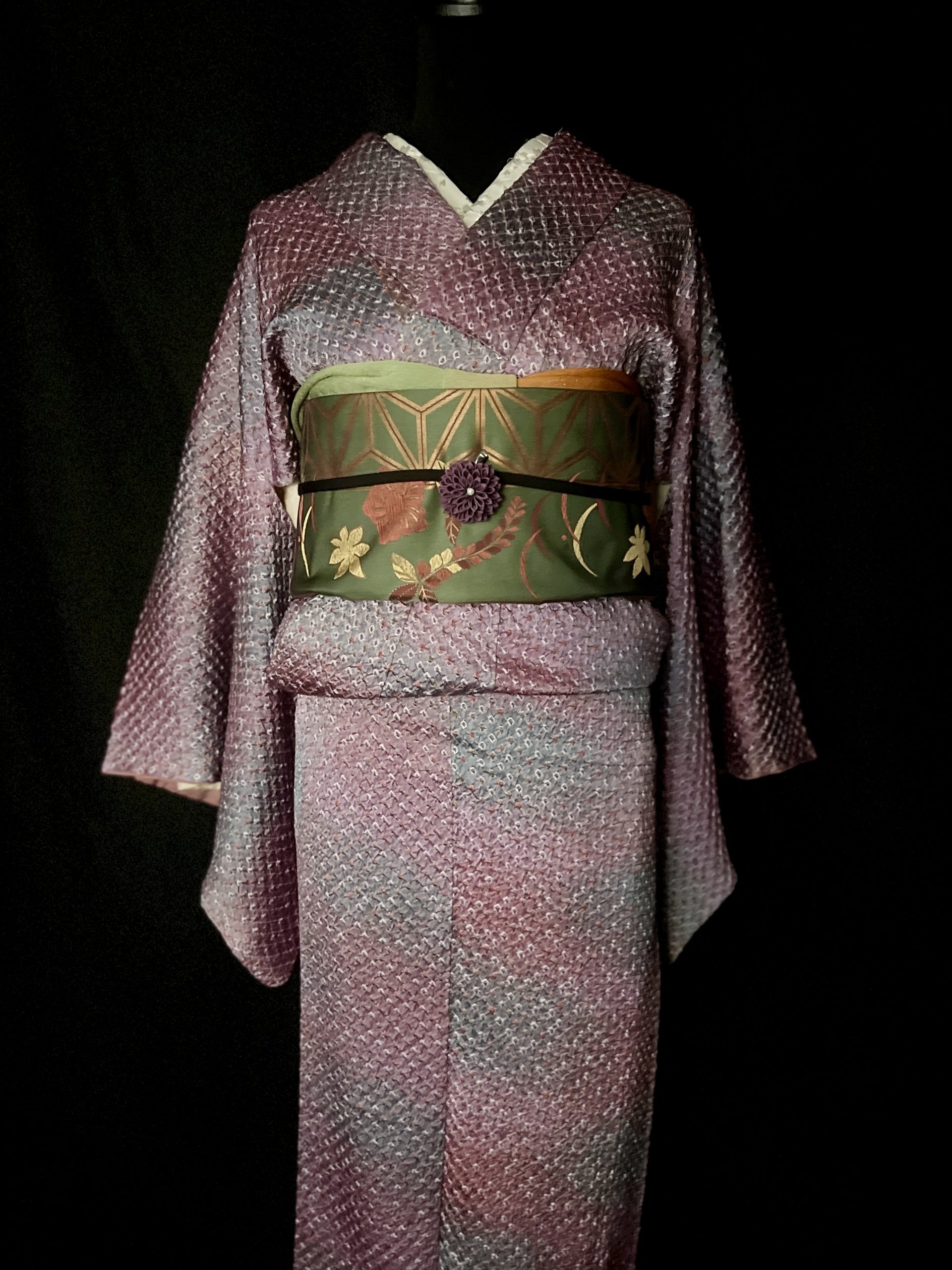
One of the first things many people notice about kimono is the obi.
It is wide.
It is beautifully decorated.
And it is surprisingly long.
If you have only seen belts used with Western clothing, you may wonder:
“Why does a kimono need such a long belt?”
The answer is simple.
An obi is much more than a belt.
Its length allows it to support the kimono, create beautiful knots, and become one of the most important visual elements of the entire outfit.
Let’s take a closer look.
An Obi Does More Than Go Around the Waist
A Western belt usually wraps around the waist once and fastens with a buckle.
An obi works differently.
It wraps around the body several times before being tied into a decorative knot.
The extra length is necessary because the obi is wrapped, folded, tightened, and shaped during dressing.
If it were only long enough to go around the waist once, many traditional obi knots would not be possible.
Its length is part of its function.
Different Knots Require Different Amounts of Fabric
There are many ways to tie an obi.
Some are simple.
Others are elaborate.
The otaiko musubi, commonly worn with many formal and semi-formal kimono, creates the familiar box-shaped knot on the back.
The bunko musubi has a ribbon-like appearance and is often seen with yukata.
Other styles create completely different silhouettes.
Each knot uses the fabric in a different way.
Longer obi provide enough material to fold, wrap, and shape these beautiful forms.
There Are Different Types of Obi
Not every obi is the same.
Different occasions call for different types.
Some of the most common include:
- Fukuro obi – often worn for formal occasions.
- Nagoya obi – a popular choice for many everyday kimono.
- Hanhaba obi – a narrower obi frequently paired with yukata and casual kimono.
- Heko obi – a soft, flexible obi with a relaxed appearance.
Each type has its own typical length, width, and purpose.
So while obi are generally long, they are not all exactly the same size.
The Obi Helps Create the Overall Kimono Style
Many people assume the obi exists simply to hold the kimono closed.
In reality, its role is much greater.
The kimono has already been arranged with dressing accessories such as koshi-himo and datejime before the obi is tied.
The obi then helps stabilize the finished appearance while becoming the visual centerpiece of the outfit.
Changing the obi can completely transform the impression of the same kimono.
Its color.
Its pattern.
Its texture.
Its knot.
Together, these elements influence the mood of the entire ensemble.
A Long Piece of Fabric Full of Possibilities
At first, an obi may seem unnecessarily long.
But that length allows remarkable creativity.
It can be wrapped.
Folded.
Layered.
Shaped.
Every movement of the fabric contributes to the final appearance.
This flexibility is one reason kimono styling offers such variety.
The same kimono can look elegant, playful, refined, or seasonal simply by changing the obi.
The Obi Reflects Both Beauty and Function
Japanese design often combines practicality with beauty.
The obi is a wonderful example of this idea.
Its length is not decorative by accident.
It exists because the obi must perform several tasks at once.
It supports the dressed kimono.
It creates beautiful knots.
It adds balance to the overall silhouette.
And it becomes an important artistic feature of the finished outfit.
Function and beauty work together.
Neither exists without the other.
Looking at Obi with New Eyes
Whenever I prepare one of my grandmother’s kimono, I am reminded that the obi is never just an accessory.
The kimono may be the foundation.
But the obi gives the outfit its final expression.
Sometimes a quiet woven obi creates an elegant atmosphere.
Sometimes a brightly patterned obi brings energy to the entire coordination.
The same kimono can tell a completely different story simply by changing the obi.
That is one of the reasons I never grow tired of studying traditional Japanese clothing.
The Length of an Obi Has a Purpose
Obi are long because they do much more than hold a kimono in place.
Their length allows them to wrap around the body, create beautiful knots, and become an essential part of kimono styling.
They combine structure with artistry.
Practicality with elegance.
The next time you see a kimono, take a moment to look at the obi.
Instead of seeing a long piece of fabric, you may begin to see the craftsmanship, tradition, and creativity woven into every fold.
At alo, I enjoy sharing the hidden stories behind kimono—details that often feel completely ordinary in Japan, yet become fascinating when viewed through fresh eyes.
Related Articles
- Kimono Symbolism: Butterfly and Hemp Leaf Pattern Meanings
- What Is an Obi? A Simple Guide to the Kimono Belt
- Kimono Fabrics: What Are Kimono Made Of?
- Can Anyone Wear a Kimono? A Simple Cultural Guide
- Kimono Seasonal Motifs: Cherry Blossoms and Maple Leaves Meaning
- Kimono Colors Meaning: What Do Colors Represent in Kimono?
- What Is Tsumugi?
Explore the Grandmother’s Kimono Archive
Learn more About alo
コメント