Introduction
When you hear the word obi, you may imagine the wide, decorative sash worn with women’s kimono.
But men wear obi too.
One of the most common types is called the:
Kaku obi (角帯)
A kaku obi is much narrower than many women’s obi and is an important part of traditional men’s kimono styling.
But how wide is it?
Where is it worn?
And how is it different from a women’s obi?
Let’s take a closer look.
What You’ll Learn
- What a kaku obi is
- How wide it is
- Where men wear the obi
- What materials are used
- Common ways to tie it
- The difference between kaku obi and heko obi
- How men’s and women’s obi differ
What Is a Kaku Obi?
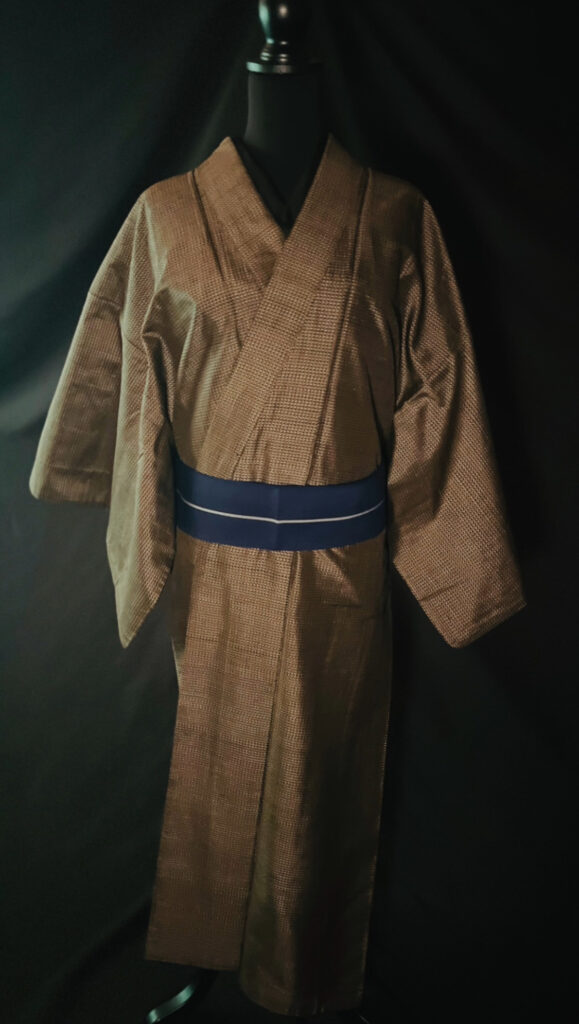
A kaku obi (角帯) is a type of narrow obi commonly worn by men.
It can be worn with traditional kimono as well as yukata.
A simple men’s kimono outfit can consist of:
Kimono + Kaku Obi
A haori or other garments can then be added depending on the occasion and style.
Although the kaku obi occupies only a small part of the entire outfit, its color, texture, and pattern can have a noticeable effect on the overall appearance.
How Wide Is a Kaku Obi?
A kaku obi is generally around 9–10 cm (about 3.5–4 inches) wide.
Exact measurements can vary.
Compared with many women’s obi, it looks quite narrow.
This narrow shape helps create the clean, understated silhouette often associated with traditional men’s kimono.
Where Is a Kaku Obi Worn?
A men’s kaku obi is generally worn lower on the body than a women’s obi.
It sits around the waist and hip area rather than covering a large section of the torso.
The position of the obi is one reason men’s and women’s kimono create noticeably different silhouettes, even though both garments share the characteristic straight lines of kimono.
What Is a Kaku Obi Made From?
Kaku obi can be made from different materials.
Examples include:
- Silk
- Cotton
- Polyester
There are also kaku obi made using traditional weaving techniques, including Hakata-ori (博多織).
Different materials and weaving methods can affect the texture, appearance, and feel of the obi when it is tied.
Choosing an obi can therefore be about more than simply finding the right color.
Are Kaku Obi Always Plain?
No.
Men’s kimono are sometimes associated with simple, understated styling, but kaku obi can feature many different designs.
You may find:
- Stripes
- Geometric patterns
- Traditional motifs
- Subtle woven designs
- Simple solid colors
Because the obi itself is relatively narrow, even a small change in color or pattern can create an effective accent.
A navy kimono paired with one obi can feel very different from the same kimono worn with another.
How Do You Tie a Kaku Obi?
There are several ways to tie a kaku obi.
One of the best-known knots is:
Kai-no-kuchi (貝の口)
It creates a relatively compact knot and is commonly associated with men’s kimono and yukata.
Other tying styles also exist.
For beginners, you do not need to memorize every knot immediately.
The important thing to understand is simply:
A men’s obi can be tied in different ways too.
The knot is part of the overall kimono style.
Kaku Obi vs. Heko Obi: What’s the Difference?
Kaku obi is not the only obi men can wear.
Another type is the heko obi (兵児帯).
The easiest difference to understand is their structure and feel.
Kaku Obi
A kaku obi has a relatively firm, structured shape.
It can be worn with kimono and yukata and creates a neat, defined appearance.
Heko Obi
A heko obi is softer and more flexible.
It can create a more relaxed appearance and is often associated with casual dressing, including yukata.
So while both can be worn by men, they create different looks and feel different when tied.
How Is a Men’s Obi Different From a Women’s Obi?
Women wear several different types of obi, including:
Fukuro obi (袋帯)
Nagoya obi (名古屋帯)
Hanhaba obi (半幅帯)
Many of these are wider than a men’s kaku obi.
The obi can also occupy a much larger visual area in women’s kimono styling.
A simple comparison looks like this:
| Feature | Men’s Kaku Obi | Women’s Obi |
|---|---|---|
| Width | Usually around 9–10 cm | Often wider, depending on type |
| Position | Around the waist/hips | Covers more of the torso |
| Appearance | Narrow and understated | Can become a major visual feature |
| Examples | Kaku obi | Fukuro, Nagoya, Hanhaba obi |
Exact styling varies according to the type of obi, kimono, and occasion.
Look at the Back of a Men’s Kimono
When looking at kimono, it is easy to focus only on the front.
But the back can tell you something interesting too.
The shape of the obi changes depending on how it has been tied.
Once you learn about knots such as kai-no-kuchi, you may start noticing these small differences when looking at men wearing kimono.
It is another way to appreciate traditional Japanese clothing beyond simply looking at colors and patterns.
A Small but Important Part of Men’s Kimono
Compared with many women’s obi, a kaku obi may appear surprisingly small.
But that does not make it unimportant.
Its color can connect the kimono with the haori.
Its woven texture can add subtle detail.
Its knot changes the appearance from behind.
And its position helps create the characteristic silhouette of men’s kimono.
In men’s kimono styling, small details can make a big difference.
Conclusion
A kaku obi is one of the most common types of obi worn with traditional men’s kimono.
The basic points are:
- It is much narrower than many women’s obi
- It is generally around 9–10 cm wide
- It is worn around the waist and hip area
- It can be worn with kimono or yukata
- Silk, cotton, polyester, and traditional woven versions exist
- Kai-no-kuchi is one well-known way to tie it
- It is different from the softer heko obi
The next time you see a man wearing kimono, look at the narrow band around his waist.
What may first appear to be a simple piece of fabric is actually an important part of the outfit.
And once you start noticing the obi, men’s kimono becomes even more interesting to look at.
Related Articles
- Kimono Symbolism: Butterfly and Hemp Leaf Pattern Meanings
- What Is an Obi? A Simple Guide to the Kimono Belt
- Kimono Fabrics: What Are Kimono Made Of?
- Can Anyone Wear a Kimono? A Simple Cultural Guide
- Kimono Seasonal Motifs: Cherry Blossoms and Maple Leaves Meaning
- Kimono Colors Meaning: What Do Colors Represent in Kimono?
- What Is Tsumugi?
Explore the Grandmother’s Kimono Archive
Learn more About alo
コメント